July, 2003, Backpacking & Longs Peak
 Longs Peak in Colorado's Rocky Mountain National Park stands at 14,255', and is the 18th tallest mountain in the continental US
(the highest peak in the entire US is Mt. McKinley/Denali, in Alaska [unless you count underwater, in which
case the highest base-to-peak mountain in the world is Hawaii]). Longs is only a couple hundred feet lower than
California's Mt. Whitney which stands at 14,494' and is the tallest in the continental US. Of the
seventy continental US peaks over 14,000'
the ascent difficulty spans from a difficult technical climb to an easy, air-conditioned drive to the top (e.g. Pike's Peak [dirt road],
Mt. Evans [paved road], maybe some others). Longs peak is somewhere in the middle of this spectrum with a non-technical "path" all
the way to the top. I quote "path" since that last mile and a half of this route are not for the faint of heart. There are numerous
"mistake = death" spots which must be negotiated.
Longs Peak in Colorado's Rocky Mountain National Park stands at 14,255', and is the 18th tallest mountain in the continental US
(the highest peak in the entire US is Mt. McKinley/Denali, in Alaska [unless you count underwater, in which
case the highest base-to-peak mountain in the world is Hawaii]). Longs is only a couple hundred feet lower than
California's Mt. Whitney which stands at 14,494' and is the tallest in the continental US. Of the
seventy continental US peaks over 14,000'
the ascent difficulty spans from a difficult technical climb to an easy, air-conditioned drive to the top (e.g. Pike's Peak [dirt road],
Mt. Evans [paved road], maybe some others). Longs peak is somewhere in the middle of this spectrum with a non-technical "path" all
the way to the top. I quote "path" since that last mile and a half of this route are not for the faint of heart. There are numerous
"mistake = death" spots which must be negotiated.
There are two approaches to climbing Longs. The most common approach (and I do mean common: on the order of 300 people per day climb Longs Peak - on the weekends the number doubles to 600 per day) is to start from the Longs Peak ranger station along Rt. 7 on the east side of RMNP. This way means you start from your car at about 9,400', hike about eight miles and 5,000' up to the top, take a few pictures, and then turn around and head back to the car. Since early afternoon thunderstorms are common you have to get all this done well before noon. Most people start this hike at around 3:00 or 4:00 in the morning, some start as early as midnight.
About fifteen years ago I did exactly this with Mike Olan (I have a few pics low down on this page: http://www.mellman.net/bill/images/camping/). Mike and I were on the trail by about 4:30am. I think we got back to the car at 8:00pm (it might have been 6:00, but it was between 14 and 16 hours of hiking). The ironic thing is that of the eight miles to the top the last 1.5 miles take as long to do as the first 6.5! This is a daunting climb, and yet some remarkably non-stereotypically "fit" people make it all the way to the top. On the other hand many people have died trying. One person on the trail this year told us that two people fell to their deaths not more than about two weeks apart (I think this happened last year).
This year I went with Tom Moriarty, and his daughter Sally. We took the second approach which is, rather than to go light in one day, go
heavy over several days. We reserved campsites that approached Longs from a slightly longer trail than from the Longs Peak ranger station.
Thus instead of having a single 8 mile killer day we had a roughly 3.5 mile day, followed by a 5 mile day, followed by the final 1.5 mile
rock scrambling portion of the final ascent to Longs (recall that this part takes as long to do as a normal 6.5 mile uphill trail hike),
and finally, on the last day, we had a 7.5 mile downhill hike with somewhat lighter packs. To do this route
Tom reserved for us the backcountry campsite
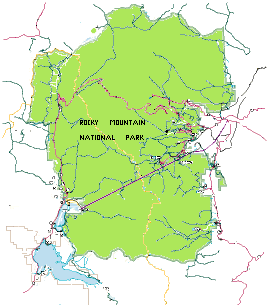 "Boulder Brook"
on the 27th, and then two nights at the backcountry campsite
"Boulderfield".
We climbed Longs on the day between the two Boulderfield campsites.
"Boulder Brook"
on the 27th, and then two nights at the backcountry campsite
"Boulderfield".
We climbed Longs on the day between the two Boulderfield campsites.
There is backcountry trail all the way to the Boulderfield campsite. This trail is mostly course packed sand and rocks, but it's smooth enough to allow horse traffic. Horses can go as far as the Boulderfield camp site (you can see the hitching post in a few of the pics), but that's as far as horses can go. Immediately out of camp the trail turns into what the camp is named for: a boulder field. This is the first of five unique stages one must get through to get to the top. These connected stages wrap nearly entirely around the mountain making the entire final portion an ever rising spiral.
After the boulder field you must pass through a notch in the rocks named "The Keyhole". From this point on there is, more or less, danger all the way. Once through the keyhole you make a sharp left changing from due west toward the keyhole, to due south across "The Ledges". The ledges are probably the safest part of the scramble. Most of the drops falling away from the trail are sloping drops of no more than 500 or so feet. However, in order to make such a fall you first have to fall, without recovering, about 30 or 40 feet of roughly 30 degree slope. In all likelyhood you would not roll all the way to the truly dangerous 500 foot drops (these are at something on the order or 45 degrees or steeper, but 500' of that will kill you just as well as a sheer drop if you're tumbling out of control).
There is really only one spot along the ledges where there is no margin for error, and here rangers, or someone, has cemented in two steel bars which you can use as handholds. By the time I was returning, however, I was so utterly exhausted that holding onto these bars was non-trivial. Since, I'm here, typing this, I obviously made it back, but not until after Tom shouted "that's not a foot hold!" to me as I was blindly lowering myself past the steel bars (thanks Tom).
After the ledges comes "The Trough". This is psychologically slightly easier since you're in, well, a trough. A corner in the rock face. That means there's less "exposure". In climbing jargon "exposure" is not being exposed to the elements, but refers to, more or less, the amount of air behind you. If you're climbing on an outside corner where there is drop off on all sides your mind is much more aware of the height. That bothers almost everyone a little bit. One could be on an equally challenging inside corner, but your mind wouldn't be screaming as loudly since you wouldn't have quite the same sense of the height since there are rock walls acting as blinders for you. Thus the trough doesn't seem as bad, and in fact, it probably wasn't as dangerous. In the trough, I believe, Tom's line of "I wasn't afraid of falling 500 feet as much as I was of falling 10 or 20 feet" was most appropriate. To really kill yourself on the trough you'd pretty much have to fall to the ice field. If you ever hit the ice field you'd slide to certain death. While never going over a precipice the ice did steepen so that you'd quickly tumble, and that would kill you. If one had an ice ax, and were trained, you could stop yourself, but I don't think you could do it without the ice ax. The only other danger in the trough was that there were a great many loose rocks, so those scrambing above you posed a danger.
At the top of the trough (after negotiating the loudly growling marmot who seemed to want some sort of toll [in the form of food I suspect]), you get to "The Narrows". The step from the trough to the narrows is harrowing. The exposure is extreme! Here you are truly on a narrow ledge over a 500 foot sheer drop. No steel bars here. The first time I did Longs I had to do this on my hands and knees. This second time I chose to remain upright, and use the higher hand holds, but only because I was using my full backpack as my daypack so it was bulky (though not really weighty), and had lots of loose, grabby, straps. I was afraid if I went on my hands and knees I would catch on the overhanging portion which I bypassed by remaining upright. It's hard to explain. Suffice it to say this is an extremely scary spot of the hike.
But then, all of the narrows is scary. There is essentially no safety margin. There is no more than about 10 feet of steep rock before the big drop. Thus if you trip and/or fall it's over (figuratively and literally). The good thing about the narrows is that it's short, and only the moves at the start and at the end are truly harrowing. At the end of the narrows is another tricky move with essentially no safety margin. It's not a super difficult move, but one slip and you're dead. After you negotiate this you transition to the final segment of the climb: "The Homestretch".
Ordinarily the homestretch is not truly deadly. In fact, on my first ascent of Longs some 15 or so years ago, other than the lack of oxygen, I more or less relaxed on the homestretch. Here you're climbing up a, probably, 30 degree, mostly smooth rock face. Below you is 40 or 50 feet of the same before you get to a 500 foot sheer drop. To really kill yourself with certainty you'd have to fall spectacularly so that you tumbled all the way to the sheer stuff, and ordinarily that wouldn't be likely. On my first climb this was the case: it was not very likely, and thus I had relatively little fear. However, this year many parts of the homestretch were wet, and that made it relatively quite slick. While on dry rock this slope could be walked up with only the friction of your boots, when wet it became much more difficult. Hand and foot holds had to be used all the way.
This year the other dangerous part of the homestretch was the traffic jam. There were probably about 50 people scrambling up the corner of this rock face. Half going up, and the other half going down. I actually had to wait at several points for people to move past me, and this is while the afternoon clouds were beginning to build. In fact, however, this was not really a great hardship since I had to stop to catch my breath just about every third step anyway.
Finally, after the homestretch, you're on top. Both times I made the top of Longs I could only stay a few minutes since, in both cases, the clouds were just at the point of starting to let loose (in fact we had some light sleet coming down this year). But I managed to look out, take some pics, sign the log, and ponder the accomplishment on both occasions. The first time I did Longs I knew it was an accomplishment, but over the years some of the edge of that had worn off. This year, I got a booster shot. Wow! That is a hell of a climb.
Going back down was very nerve wracking for me. I knew what lay ahead, and I knew how tired I was. The first time I pretty much enjoyed, if pantingly so, every portion of the climb. This year I have to say I did not enjoy the descent. The only good thing was it was not quite as bad, as my fatigue had built it up to be. The sleet did not help, but once past the trough (where most of the sleet came) it wasn't really a problem. With each phase of the descent completed I gave a little sigh of relief knowing I wouldn't ever have to do that again. And once I was past the narrows it was more fatigue than fear that was bothering me. Going down the trough was not too bad, and I had more fear of loosing a rock onto someone below me than I did of falling to my death. I did have the one tricky move on the ledges (the one with the steel bars) looming, but I knew that once I was past that I was truly home free. And, other than the afore mentioned shout from Tom even that move went past uneventfully.
Before the start of the climb to the top I was entertaining the thought of just going down to the cars that day. From the Boulderfield site, looking up at the keyhole before the climb, I'd forgotten from before, just how tough the climb was. I mentioned the thought to Tom, he was all for it too. Needless to say, once we completed the climb to the top all three of us unanimously agreed there was no way we had the energy to hike out. Thus next day, as the original plan had us doing, we hiked out the roughly 7.5 miles to the Bear Lake shuttle bus. Roughly 30 hours later I was home feeding the kitties.